I am a free-lance writer specializing in profiles of news-makers and Central New York business news and trends.
I have taught newswriting and ethics courses at the S.I. Newhouse School of Public Communications at Syracuse University. I earned a bachelor's degree in English literature from the State University College at Oswego (1977) and a master's degree in newspaper journalism from Newhouse (1999). I began teaching at Newhouse in 2000, and I continue to teach there.
I took early retirement from The (Syracuse) Post-Standard in May 2007 after 27 years of working there as a reporter, copy editor, news designer, front-page editor, editorial writer, night city editor and bureau chief. I have written frequently for CNY Business Exchange, CNY The Good Life and several other regional magazines.
I've also won awards for newspaper editing and design.
Among the courses that I've taught at SU are:
NEW205 (introduction to news writing),
NEW305 (intermediate writing and reporting),
NEW345 (critical perspectives on the news),
NEW605 (Boot Camp for incoming grad students),
NEW608 (Principles of journalism and ethics) and
NEW617 (advanced reporting and writing grad course).
Syracuse University Chancellor Nancy Cantor has left her mark on Syracuse.
Conspicuous community outreach efforts --- including the Say Yes to Education program in the city’s
schools, the Southside Partnerships, the Near West Side Initiative and Connective
Corridor --- have had ups and
downs and attracted supporters and critics with a surprising amount of passion. As Cantor departs to
head Rutgers University/Newark in New Jersey and new SU chancellor Kent Syverud
prepares to take his own place here, those programs are still spinning out
impacts in the community. Many of the people linked to
these programs are wondering: Will Syverud give his
blessing to Scholarship in Action or will the focus return to building up the
university’s clout and influence within its walls and in the far-flung power
centers in New York, Los Angeles and elsewhere?
This story by Walt Wasilewski in Dec. 11, 2013, edition of The Syracuse New Times tells the tale:
Rita Reicher grew up in Central New York, and knows it well. She also knows how to help multi-national corporations figure out how to improve their products and understand the minds of consumers. She was there at the start when KS&R, one of the nation's top consumer and market research companies, was founded. Now she is its president. Here is a profile that I wrote about her that is the April 2012 cover story of CNY Business Exchange. Click on each page for a readable version.
The cover of the February/March edition of CNY Business Exchange magazine features a story I wrote about the future of one of the biggest engines behind our local economy: health care. What happens to health care here affects everyone's pocketbook. The predictions from experts on what's coming soon may surprise you. Here is a link to the full story:
A German company, Bitzer Scroll, has quietly invested tens of millions of dollars to build a high-tech factory here in CNY. The company is looking for a local site to build an even bigger factory to make new air conditioning compressors that were pioneered by an elite group of local engineers. It's an unexpected twist in the legacy of the air conditioning industry in CNY, which began in the long-ago days of Willis Carrier. Here is a link to a story I wrote about this for November 2011 edition of CNY Business Exchange:
I wrote a cover story for the April 2011 edition of CNY Business Exchange about McConnellsville's Harden Furniture. One family has owned and operated the business for five generations. How did they do it?
Here is a link to the story as it appeared in the magazine: http://bit.ly/oLXpK5
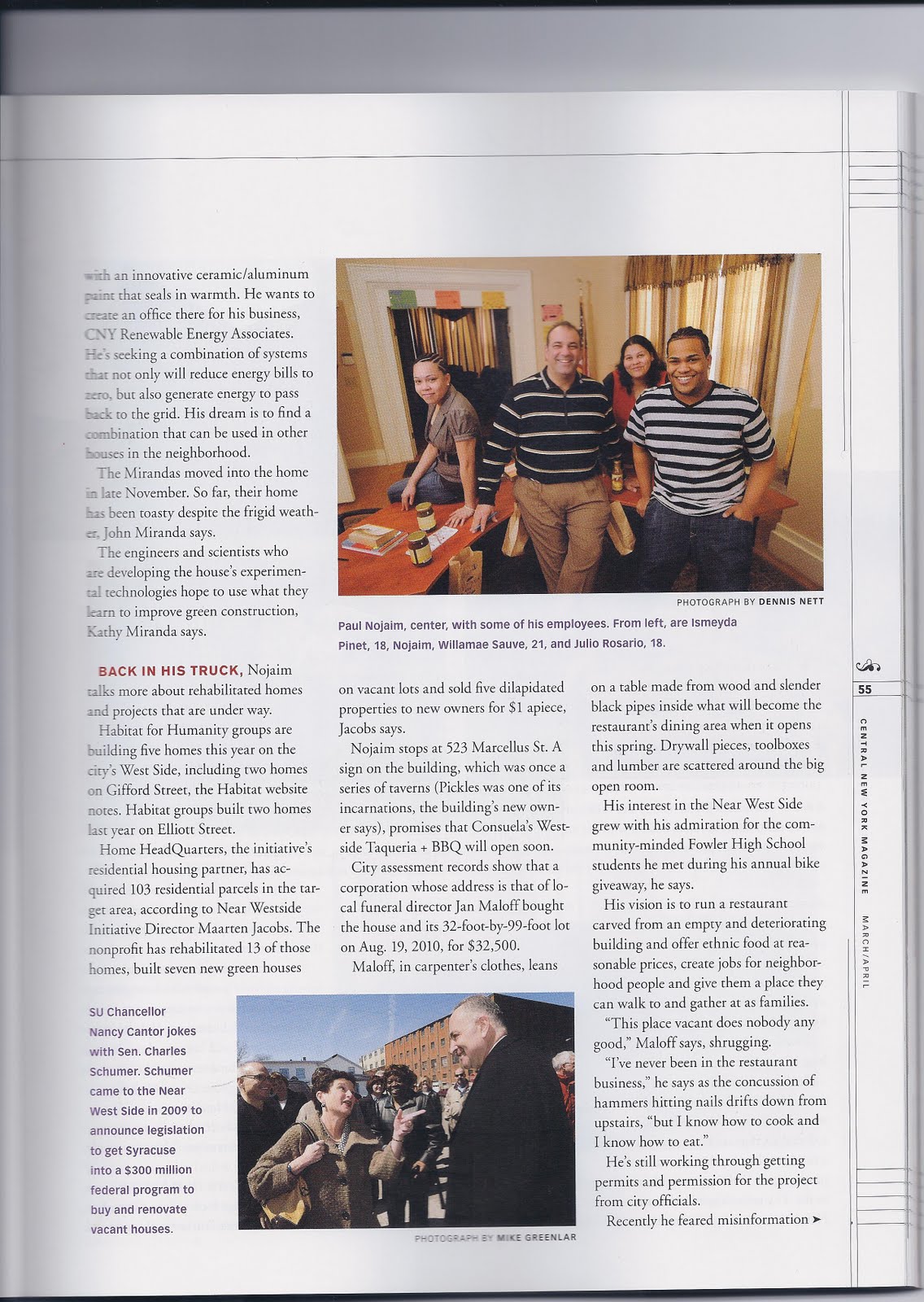
Here are the pages from CNY: The Good Life's March 2011 edition and my story on the changes that are rising up on Syracuse's Near Westside. You can read the story by putting your cursor on the first page and then flipping through the images
Twitter is highly searchable. You can find out what topics are most discussed, find sources who are discussing a certain topic – the uses are as endless as your imagination. Here is the site on Twitter that is a tutorial on how to best use the search function:
This site is outstanding, because it not only measures the volume of tweets on particular topic, but also measures whether the tweets are positive or negative and a ton of other metrics:
If you are looking for journalism news and links to how-to sites for reporters, here is a list of hashtags used on Twitter that can streamline your searches:
Here are eight sites to help you get the most out of your tweets – a thesaurus that finds shorter words, a translator of Twitter jargon, even a program that helps you squeeze long sentences into short ones (this sounds like a reporter’s dream and a helluva short cut):
Some how-tos about using social media to brand your company; this also has some good links at the end of the story about how to use social media metrics.
Certain pages on Facebook, such as U.S. Politics on Facebook, carry coverage of events. This page charts Facebook usage during the State of the Union Address. You can search Facebook in the search field for hot topics and see such pages.
How journalists used Twitter in the wake of the Arizona congresswoman’s shooting. It’s an example of the innovative ways that journalists are using technology to monitor the i-world and join the conversation.
The New York Times Review of Books interviews subway passengers who are reading books on the train what they think of them, and present it as a cartoon with talk bubbles:
How to build narratives using multimedia and innovative storytelling:
http://transom.org/?p=13808
You can use Google.docs, which is similar to PowerPoint, to make low-tech animations similar to the old-time flash cards. You produce lots of pages, order then and you simulate the flip books of another era. Except these are digital and can be share with anyone who can view a web site or receive e-mail.
http://techcrunch.com/2011/01/05/google-docs/
The Washington Post recently constructed a story told entirely from a series of Facebook status updates. The concept is an old one, similar to telling a story via a series of diary entries. But this is the digital age version:
This was a viral digital sensation among journalists and those who love them for a few weeks. There are now versions of “so, you want to be a television reporter,” and so one. It’s the savage truth about journalism in a short and oddly Sim-robotic video:
http://www.xtranormal.com/watch/8045747/
A very funny speedie version of all the information from the WikiLeaks in video format quick-quick:
This is a pretty dated and newspaper centric list of 25 ways to find good stories, but the it captures the spirit of shoe leather, deputizing people in the know and keen reportorial observation:
The Maxwell School has a course called Community Benchmarks, and its students do all sorts of surveys about the local community. It is a treasure trove of data about the campus and Syracuse:
Some information about SU’s budget and other spending from Middle States accreditation document the is named 2008 SU SelfStudy pdf found in NEW305 file.
Bird Library is one of SU stealth genius ways to find information. Here is one aspect of an amazing resource, the secrets of Bird Library’s sixth floor: